
← All frameworks

Flagship Framework

SEL National Behavioural Framework

A research-informed framework designed to support social and emotional skills through practical resources and an evaluation approach. “National” describes its intended scope, not government endorsement or nationwide adoption.

Behaviour is the result of how individuals think and feel.

Thoughts → Emotions → Behaviour → Social Outcomes

Overview

A system-level behavioural infrastructure

Social and emotional learning offers ways to develop awareness, self-management and relationship skills across educational and community settings.

The SEL National Behavioural Framework responds directly to that gap. It brings together a research-informed design, practical activities and a proposed pathway for delivery and evaluation. Its specific outcomes need to be assessed through implementation.

Learning activities → Skills practice → Outcomes to evaluate

Behavioural Foundation

Establishes the relationship between thoughts, emotions and behaviour as the primary drivers of human action.

Competency Development

Structured development of core SEL competencies: self-awareness, emotional regulation, social awareness, relationship skills and responsible decision-making.

Practical Implementation Tools

Supported by the SEL Behavioural Development Handbooks for Kids & Teens and Youth & Adults, connecting practical activities with everyday life.

Measurement & Evaluation Systems

An approach to tracking delivery and evaluating potential changes in skills and relationships.

Why SEL

Social and emotional skills can support positive behavioural development

Social and emotional learning can contribute to positive development alongside economic, social, institutional and other support. It does not address every cause of a complex social problem.

GBVF & Domestic Violence

Skills and factors this framework can address
Emotional regulation, empathy and respectful communication
SEL intervention
Self-awareness, empathy, impulse control
Behavioural shift
Respectful relationships to evaluate

Crime & Gang Culture

Skills and factors this framework can address
Belonging, conflict management and relationship skills
SEL intervention
Social skills, purpose-building
Behavioural shift
Constructive conflict responses to evaluate

Youth Unemployment

Skills and factors this framework can address
Self-management, goal-setting and decision-making
SEL intervention
Goal-setting, decision-making
Behavioural shift
Confidence and initiative to evaluate

Mental Health Crisis

Skills and factors this framework can address
Emotional awareness and everyday coping skills
SEL intervention
Coping tools, emotional awareness
Behavioural shift
Coping skills and wellbeing to evaluate

School Drop-out

Skills and factors this framework can address
Engagement, self-awareness and relationships
SEL intervention
Motivation, growth mindset
Behavioural shift
Engagement and participation to evaluate

Competencies

The core competencies developed

Self-awarenessSelf-management & emotional regulationSocial awareness & empathyRelationship skillsResponsible decision-makingCritical thinkingResilienceEthical decision-making

Delivery Tools

The practical tools that deliver the framework

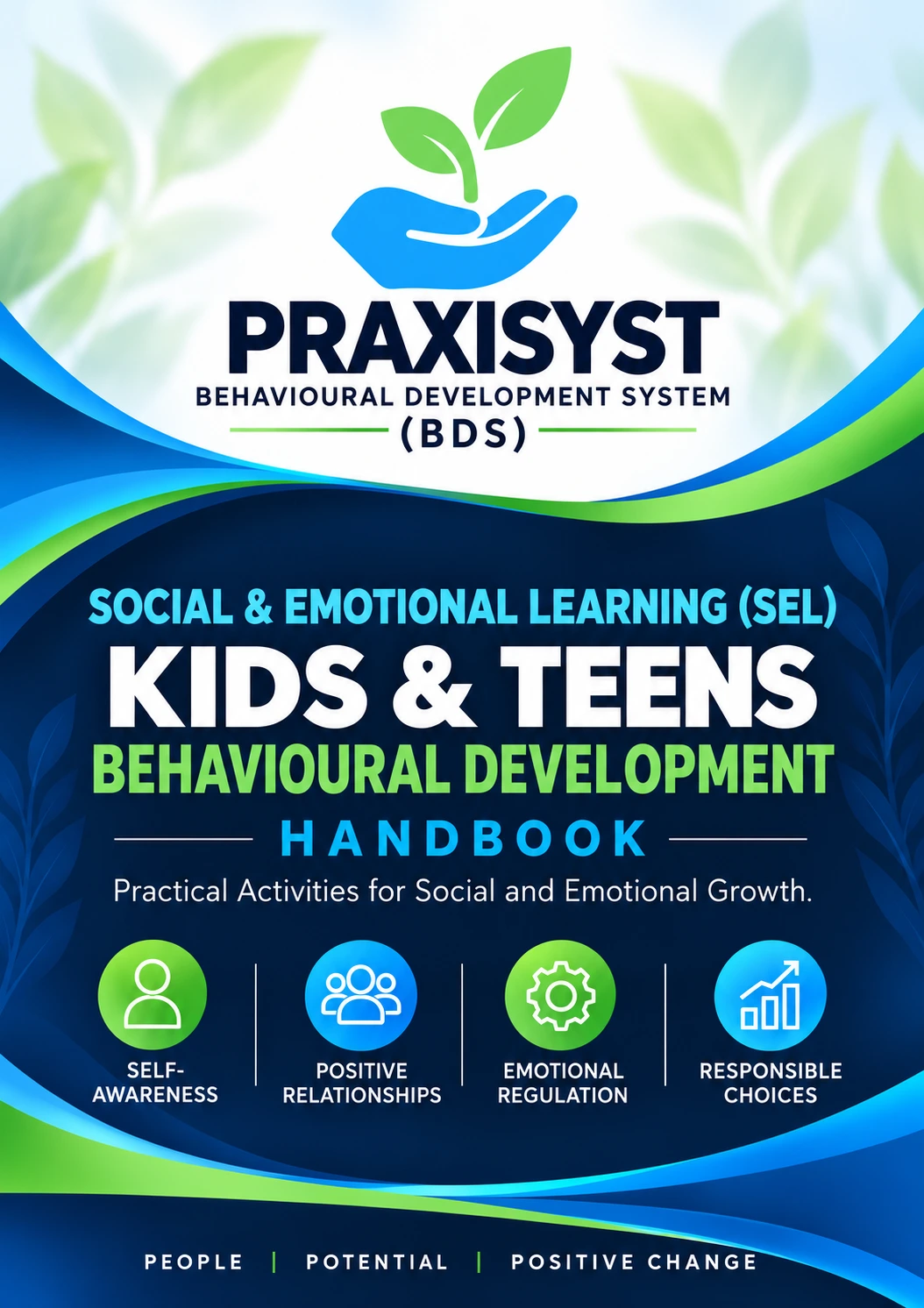
Cover of the Social & Emotional Learning (SEL) Kids & Teens Behavioural Development Handbook

Social & Emotional Learning (SEL) Kids & Teens Behavioural Development Handbook

For:
Kids and teens; teachers, parents, caregivers and facilitators
Purpose:
Practical Activities for Social and Emotional Growth.
Format:
Behavioural development handbook
Availability:
Please enquire about samples and licensing.
Request samples or licensing information

Sample activities

Mirror of MeSelf-awareness · Handbook page 8
  1. Stand in front of a mirror and notice your expressions.
  2. Make three different faces: happy, sad and surprised.
  3. Think about how each face feels inside.

Optional: Draw or colour your different expressions on a blank page.

ReflectionWhich face was easiest to make, and why?

My Strength ShieldSelf-awareness · Handbook page 9
  1. Draw a shield on paper.
  2. Inside, write or draw four of your strengths, such as kindness, creativity, bravery or teamwork.
  3. Decorate your shield with colours and symbols.

Optional: Share your shield with a friend or family member.

ReflectionWhich strength makes you proudest, and why?

Emotion CharadesSelf-awareness · Handbook page 10
  1. Write different emotions, such as happy, angry, scared, excited and worried, on small pieces of paper.
  2. Put them in a bowl.
  3. Take turns acting out the emotions without words while others guess.

Optional: Draw one of the emotions after the game.

ReflectionWhich emotion was hardest to act out?
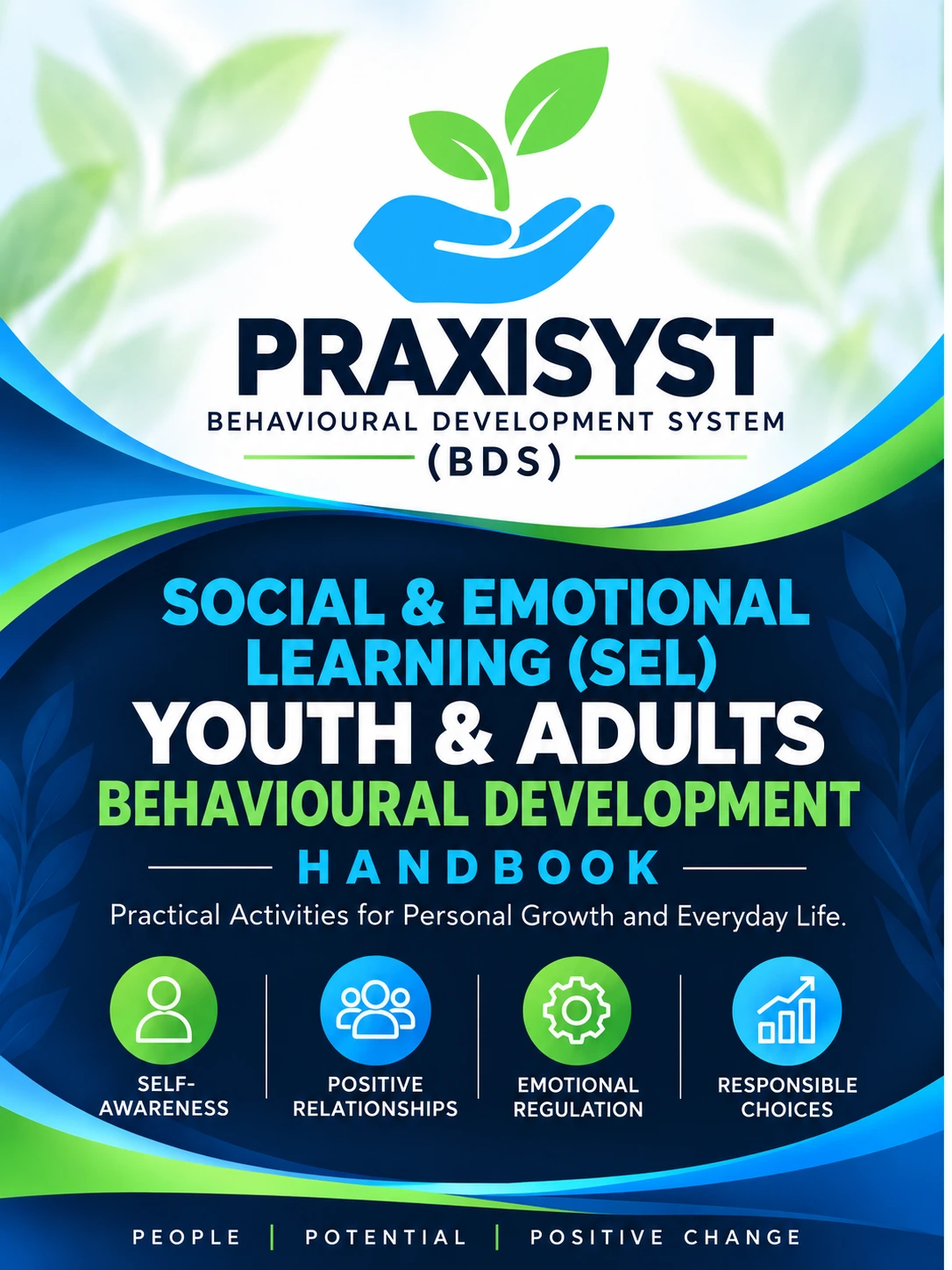
Cover of the Social & Emotional Learning (SEL) Youth & Adults Behavioural Development Handbook

Social & Emotional Learning (SEL) Youth & Adults Behavioural Development Handbook

For:
Youth and adults; teachers, facilitators, mentors and caregivers
Purpose:
Practical Activities for Personal Growth and Everyday Life.
Format:
Behavioural development handbook
Availability:
Please enquire about samples and licensing.
Request samples or licensing information

Sample activities

Emotion JournalSelf-awareness · Handbook page 8
  1. Keep a daily journal for one week.
  2. Write down two emotions you felt most strongly each day.
  3. Note what triggered them and how you responded.

Optional: Use symbols, colours or drawings to represent your emotions.

ReflectionWhat patterns did you notice about your feelings?

Personal Values MapValues awareness · Handbook page 14
  1. Write down ten things most important to you, such as family, honesty or growth.
  2. Narrow them down to your top three values.
  3. Write why these three are most important.

Optional: Create a visual map with symbols for each value.

ReflectionDo your daily actions reflect your top values?

Stop–Think–ActImpulse control · Handbook page 29
  1. Think of a recent situation where you reacted quickly.
  2. Replay it in your mind using STOP → THINK → ACT.
  3. Practise the steps with a new scenario.

Optional: Draw a traffic light: red for stop, yellow for think and green for act.

ReflectionHow different would your outcome have been with this method?

Select activities to suit each participant’s needs and comfort. Younger learners may need support. Reflection can remain private; nobody should be pressured to share personal experiences. These educational resources do not replace professional or specialist support.

The sample activities are drawn from the current handbooks. Please enquire about full handbook availability and licensing for your setting.

Supporting delivery methods

Facilitator Orientation

Guidance on activity facilitation, ongoing programme support and flexibility in implementation for teachers and practitioners.

Guided Reflection

Structured reflection discussions that link SEL concepts to everyday behaviour and discipline.

Role-Play & Scenarios

Simulated real-life situations — bullying, peer pressure, conflict, decision-making — practised in a safe environment.

Sports Integration

Values discussions before sessions, cooperation during play and reflection on behaviour afterwards.

Arts, Culture & Creative Integration

Drama, music, storytelling, art projects and cultural activities that allow emotions to be expressed creatively.

SEL Fun Days & School Events

Whole-school engagement days that reinforce SEL practice beyond the classroom.

Implementation

Three primary implementation environments

Classroom Engagement

Teacher-led short daily activities (10–15 minutes) and weekly structured sessions focused on emotional awareness, empathy, cooperation and decision-making.

School Environment

Peer-led practice during break times — group games, peer discussions, conflict resolution exercises and cooperative challenges.

Home & Community

Family-supported engagement — handbooks taken home for family activities, parent-child discussions and reflection exercises.

The framework is adaptable to primary schools, high schools and a range of learning, support, empowerment and development settings — institutions integrate activities according to their own schedules and needs.

Sectors

A whole-of-society framework

Education

Lifelong skills for emotional regulation, resilience and responsible decision-making.

Social Development

Supporting relationship and coping skills within families and communities, alongside other services.

Health

Supporting emotional awareness and coping capacity; not a replacement for clinical care.

Safety & Security

Exploring empathy and conflict-management skills alongside wider safety measures.

Economic & Workplace

Aiming to strengthen collaboration and workplace relationships.

Community & Faith-Based

Aiming to support relationships and community participation.

Scalability

A phased expansion pathway

Phase 1

Pilot Implementation

Proposed introduction in a limited number of schools, facilitator orientation and baseline data collection to assess feasibility.

Phase 2

Cluster Expansion

Potential expansion across additional schools, informed by pilot learning and facilitator capacity.

Phase 3

District-Level Integration

Potential engagement with district authorities and shared learning across participating institutions.

Phase 4

Provincial Adoption

Potential alignment with provincial priorities if evidence and partnerships support wider use.

Phase 5

National Integration

Longer-term possibility of engagement with national stakeholders, subject to evidence and approval.

Beyond education, the framework is designed for cross-sector expansion into corporate wellbeing, community and youth development, public institutions and preventative health and wellness strategies.

Impact

Intended outcomes and evaluation horizons

These are aims to assess, not measured results or promised timelines.

During delivery

  • Record activities delivered and participation
  • Gather facilitator and participant feedback

After participation

  • Assess changes in emotional vocabulary and self-awareness
  • Explore relationship and decision-making skills

With longer follow-up

  • Evaluate whether skills are sustained in everyday settings
  • Review what worked, for whom, and under what conditions

Measurement

An evidence model built into delivery

Inputs

  • SEL Behavioural Development Handbooks: Kids & Teens and Youth & Adults
  • Facilitators (teachers, practitioners, programme leads)
  • Structured implementation methodology

Activities

  • Daily and weekly SEL activity integration
  • Guided reflection and facilitated discussion
  • Behavioural reinforcement practices

Outputs

  • Activities delivered
  • Participants reached
  • Facilitators oriented
  • Resources distributed

Outcomes

  • Improved self-regulation and decision-making
  • Changes in emotional awareness to evaluate
  • Changes in relationships and behaviour to evaluate
  • Changes in resilience to evaluate

Potential evaluation methods include baseline assessments, facilitator observations, participant reflections and feedback. Existing SEL research informs the design; evidence from Praxisyst-specific pilots has not yet been published here.

Case Studies

Implementation evidence

No documented, authorised Praxisyst case studies are published yet. This area will share findings once implementation evidence is available and publication is approved.

Become a pilot partner